Tuesday, 10 February 2015
Tomorrow we'll be back to our regularly scheduled programming
We've taken a brief hiatus over the last couple of weeks but shall return tomorrow.


Sunday, 1 February 2015
The Väsen
No man, who is not inflamed by vain-glory into enthusiasm, can flatter himself that his single, unsupported, desultory, unsystematic endeavours are of power to defeat the subtle designs and united Cabals of ambitious citizens. When bad men combine, the good must associate; else they will fall, one by one, an unpitied sacrifice in a contemptible struggle.
I would, that it were so easy....
The world of is locked in a struggle. In-corruption puts on corruption and fires her vacuous arrows of righteousness into a darkness she cannot pierce. Not because light cannot rend it asunder but because you cannot play in the dirt without staining your clothes, and she has long been wallowing in filth.
Once, she had many names: Sol'Väsen, guardian, light bringer, slayer of the hordes, bane of the Mör’ Väsen, but she came to the realisation that rent her soul in twain and shattered her faith. Her Väsen, no longer deserved salvation.
At first glance nothing seems amiss, but even the simple common folk can smell the rot in the air. All is not well. Hidden within all of the civilizations, cultures and nationalities of Khardan are the great cabals. No one knows how these machinations came to be, only that they exist in three great combinations called the Väsen. The cabals within each Väsen share similar symbols, iconography, principles and often form political affiliations and orders which can span both races, cultures and broad geographies.
The cabals of the Väsen are most often secret orders, their memberships are guarded jealously and identification is protected by secret knowledge known only by the initiated. Sometimes common key words are used, sometimes signs, tokens or gestures identify members to each other while other less sacred signs are used to identify members of allied cabals. Almost always, there are specific rituals for induction and advancement within these orders as well as emergency calls that identify a brother or sister in need of immediate aid.
I would, that it were so easy....
The world of is locked in a struggle. In-corruption puts on corruption and fires her vacuous arrows of righteousness into a darkness she cannot pierce. Not because light cannot rend it asunder but because you cannot play in the dirt without staining your clothes, and she has long been wallowing in filth.
Once, she had many names: Sol'Väsen, guardian, light bringer, slayer of the hordes, bane of the Mör’ Väsen, but she came to the realisation that rent her soul in twain and shattered her faith. Her Väsen, no longer deserved salvation.
At first glance nothing seems amiss, but even the simple common folk can smell the rot in the air. All is not well. Hidden within all of the civilizations, cultures and nationalities of Khardan are the great cabals. No one knows how these machinations came to be, only that they exist in three great combinations called the Väsen. The cabals within each Väsen share similar symbols, iconography, principles and often form political affiliations and orders which can span both races, cultures and broad geographies.
The cabals of the Väsen are most often secret orders, their memberships are guarded jealously and identification is protected by secret knowledge known only by the initiated. Sometimes common key words are used, sometimes signs, tokens or gestures identify members to each other while other less sacred signs are used to identify members of allied cabals. Almost always, there are specific rituals for induction and advancement within these orders as well as emergency calls that identify a brother or sister in need of immediate aid.
Sol’ Väsen – These Väsen often bear the symbol of the Celestial
Sun. The Sol’ Väsen are the so called righteous defenders of peace, order,
freedom and truth. When Sol’ Väsen are immortal species they are often
ancients, who remembering the tyranny of darker times strive for the rule of
law as a provider of peace and harmony. The Sol’Väsen are not, however, all benevolent. Their long struggle against the Mör Väsen has tainted many of them. They are likely to be as oppressive, dictatorial and corrupt as they are peaceful and
benevolent.
Jor’ Väsen – The Väsen of the lesser light
or false light, bear symbols of the moons, stars and flame, The Jor’ Väsen are somewhat
benevolent and include those who may be both sympathetic and apathetic to the highly vaunted
principles of morality, but are not wholly evil. Jor’ Väsen do not thrive in the
full light of the Celestial but they also shun the Darkness. Jor’Väsen fight as
often for what suits them as for what they believe is right. Often that can
mean allying with the Mör’Väsen as often as the Sol’Väsen.
Mör’ Väsen – The brotherhoods of eternal Night vary widely in their symbols and standards and are not always easily identifiable. The Mör’ Väsen consist of combinations that are of varying degrees of wicked from the malicious to the malignant. They are not all wholly evil, but they thrive and draw power from
the darkness, from chaos and the true freedom that comes from living in shadow
and anonymity.
Within both the Sol’ Väsen and
Mor’ Väsen exist terrorist-like extremists. These individuals exhibit
the most extreme ideological characteristics of their groups and are
distinguished from the others by the name prefix Ren. i.e. a Ren Mör’ Väsen denotes an extremely evil character while a Ren Sol’ Väsen would be either an
extremely righteous character or at least self-righteous.
Sunday, 25 January 2015
Redesigning the Setting: Drawing the Satellite View Map, 5
Continuing in the series we are going to start with creating some very important masks.
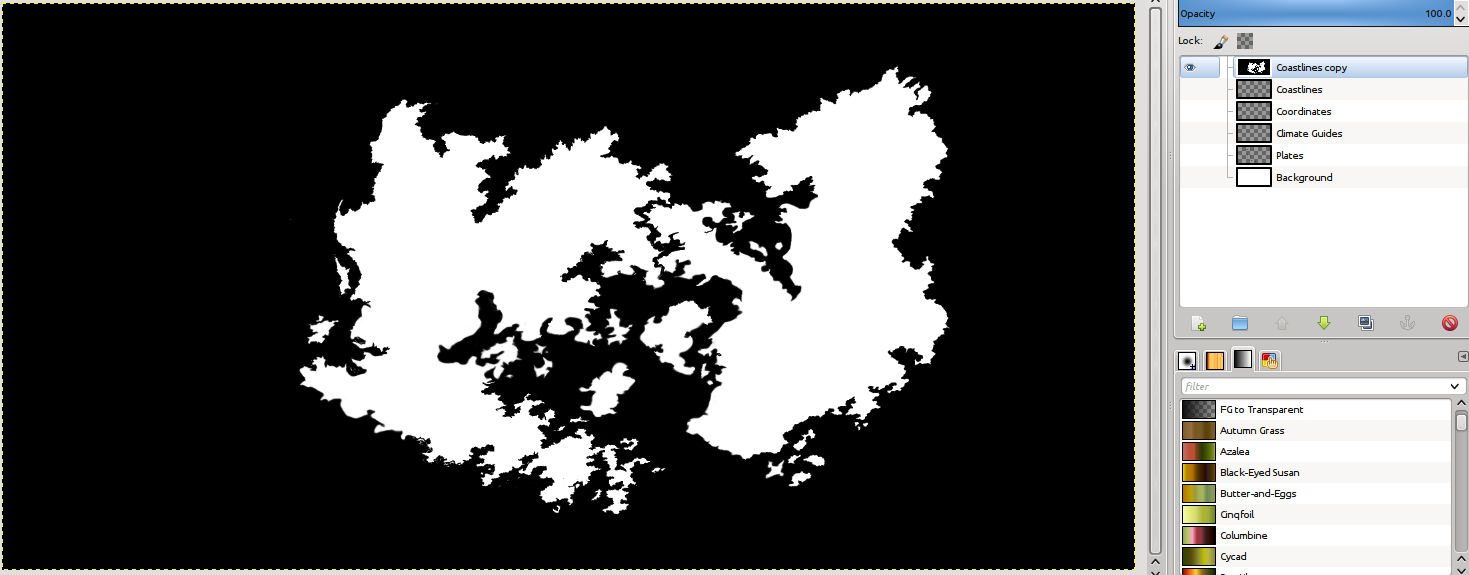 On the "Map Outline" layer we are going to fill the land in with white and the seas in with black. Ensure that the "Map Outline" layer is active and take your bucket fill tool and fill in the land and seas.
Creating the Land and Sea Masks
Before we modify anything let's create a backup of our Coastlines layer by duplicating it and naming the copy "Map Outline." Then toggle the visibility of the Coastlines layer so that it is not seen.
Layers (Coastlines) > Duplicate Layer (Name "Map Outline")
Layers (Coastlines) > Hide
On the "Map Outline" layer we are going to fill the land in with white and the seas in with black. Ensure that the "Map Outline" layer is active and take your bucket fill tool and fill in the land and seas.
Bucket Fill (Black) > Click on the area outside of the land
Bucket Fill (White) > Click on the land
Ensure that you have clean black and white boundaries before moving on (i.e. the land and sea should be flat white and black around the borders, no grey or shading.) Now, let's create the masks. On the "Map Outline" layer, select the Select by Color tool (Threshold 0) and click on the land (white) area.
Layer (Map Outline) > Select by Color (Threshold 0) > Click on Land
Now go to the Select menu tab and click on Save to Channel; name this channel “Land Mask”.
Select > Save to Channel (Name Land Mask)
We are going to repeat this process for the sea. On the "Map Outline" layer, select the Select by Color tool (Threshold 0) and click on the sea (black) area.
Layer (Map Outline) > Select by Color (Threshold 0) > Click on the Sea
Now go to the Select menu tab and click on Save to Channel; name this channel “Sea Mask”.
Select > Save to Channel (Name Sea Mask)
That is for today, next time we'll continue with beginning to create the Height Map.
Friday, 23 January 2015
Redesigning the Setting: Drawing the Satellite View Map, 4
Now that we know about winds, climate zones and tectonic plates we are ready to draw the outline of our map. I prefer to draw the map with some markers for latitude and longitude so that I know what the climate will be in those areas. To do this, add a layer called coordinates
Layer > New Layer > Transparency (Name Coordinates)
One you've drawn your lines to reference Longitude and Latitude you can remove the blue guidelines. Now, add a new transparent layer named Coastlines and put just under the Coordinates layer. Generally we will keep the Coordinates layer at the top of our layer stack.
Layer > New Layer > Transparency (Name Coastlines)
Layer > New Layer > Transparency (Name Coordinates)
Pencil > Brush (2. Hardness 100) > Colour Black
Now, using the Gimp guidelines, rules and a pencil tool draw the latitude and longitude lines at regularly spaced intervals. If you want, you can get fancy and label them. See how I've done set this up below:
 |
| Images in construction with Longitude and Latitude lines |
Layer > New Layer > Transparency (Name Coastlines)
Pencil > Brush (2. Hardness 100) > Colour Black
Now, using what you've learned, with the Coastlines layer selected, draw your continents and coastlines. You can see my completed coastline layer below.
 |
| Coastlines completed |
Wednesday, 21 January 2015
Conditional Success and XP for Failures, what do you think?
Hi, I'm looking for some feedback.
In the design of the Lycadican game mechanics, back in the late 1990's I came up with the concept of degree of success (DOS) (For details of the basic Lycadican dice mechanics see this post.) Essentially the DOS is your modified roll subtracted from the target number. A positive DOS score indicates success while a negative DOS score indicates the degree of failure.
As I work on the Lycadican redesign one of the concepts I've read about in some other systems is the 'conditional success' and awarding XP for failures. While I'm not sold on the latter the former would seem to drive interesting game play and would be very easy for me to implement. I could essentially say that any DOS from 0-3 is a conditional success. i.e. 'You Succeed, but ..' some complication or trouble results.
Those of you who have experience playing with these kinds of rules, conditional success and XP for failures, what are your thoughts? How do they contribute to gameplay? Do they detract at all? What are some of the unintended consequences?
Thanks!
In the design of the Lycadican game mechanics, back in the late 1990's I came up with the concept of degree of success (DOS) (For details of the basic Lycadican dice mechanics see this post.) Essentially the DOS is your modified roll subtracted from the target number. A positive DOS score indicates success while a negative DOS score indicates the degree of failure.
As I work on the Lycadican redesign one of the concepts I've read about in some other systems is the 'conditional success' and awarding XP for failures. While I'm not sold on the latter the former would seem to drive interesting game play and would be very easy for me to implement. I could essentially say that any DOS from 0-3 is a conditional success. i.e. 'You Succeed, but ..' some complication or trouble results.
Those of you who have experience playing with these kinds of rules, conditional success and XP for failures, what are your thoughts? How do they contribute to gameplay? Do they detract at all? What are some of the unintended consequences?
Thanks!
Tuesday, 20 January 2015
Redesigning the Setting: Drawing the Satellite View Map, 3
Last time we ended with a GIMP drawing with a transparent layer for your plates. I was going to skip right to drawing the outline of the continents until I realized that I was missing a step and that is understanding where the general climate zones will be. Both together are important and here's why:
 The earth has a number of climate zones that correspond roughly to specific latitudes. Whether they are damp or dry will also depend on the atmospheric geography of those areas. See the image to the right. You'll notice correspondences between damp tropical regions and desert regions because of where the winds are carrying moisture and dropping it. Reference the diagram below. You'll see the directions of the winds and the high and low pressure zones. At HIGH pressure zones you have dry air that has cooled falling back down to the surface. Because it has little to no moisture the areas where this air falls are likely to be dry. As the air moves across land and water it will become more humid, carrying more water vapour. It will eventually lose that moisture as rain or fog when it cools and looses its ability to carry that water vapour. It will cool when it gets forced to a higher elevation by a land formation such as a mountain or at a LOW pressure zone or when it meets a cool body of air. This diagram will also help you understand the wind patterns and how maritime peoples on your continent might get around by ship (i.e. where your tradewinds will be.)


 |
| Subduction Zone - Rocky Mountains |
- On coastlines where you have mountains near the water, those coast lines will tend to be more jagged especially the closer you get to the poles.) That said, even when you have mountains running parallel to a coast line you could still have smooth sections of coast line. This is because where 2 plates collide and form mountains will not always be right at the edge of the water. A subduction zone will often start out a distance at sea and the lighter rock of the continent will stay above it. See the image to the right.
- In the areas where you have deserts meeting coastal areas, tropical beaches, etc. you will likely have smoother coastlines due to long stretches of sand. This isn't always true of course but it's a good rule of thumb. That means you need to understand, generally where these areas will be on you map.

The last item you need to be aware of is the heating of the earth due to the Sun, it is the combination of the heating of the atmosphere and spin and tilt of the earth that drives the climate. So, as you draw your coast lines, you'll want to have a general idea of which latitudes your continent span and what the climate is like around those areas. What I did was to add some drawings like these as layers to my image and set the opacity low as I was drawing my coastline so that I had a reference point. We'll talk more about that in the next post.

Saturday, 17 January 2015
Nightmares with dreams of hope; what is Lycadican?
Lycadican is a role playing game with both fantasy and horror thematic elements. When I think about what this means my mind whispers to me "Nightmares with dreams of hope." The mood of Lycadican could very well be summed up by things I've experienced a lot of lately, sleeplessness, waking suddenly from nightmares with a sense of impending terror pierced by cherished moments of peace and a desperate hope.
I've had a lot of nightmares and a lot of dreams but for 20 years there are some that have stayed with me. No matter what I was doing or what I was aspiring to these ghosts have always possessed me.
The first was a role playing game that brought the fantastic possibilities of magic and the supernatural to life. Not with conventional wizards that need to memorize spells and priests who pray to gods for 'blessings' that are essentially spells; but instead one where magic of all kinds and forms could exist in a way that is connected to the fabric of life. One that engages players to be the creative forces behind their own magical practices. Player characters should have their own arcane tomes and these they should covet greedily, passing their secrets on only to other characters they choose to mentor.
The second was a way to infuse the fantasy I read with the superstition from my childhood, but not in a familiar way. It should be something new with echos of the familiar. It should be fantasy but feel somewhat like a story of the supernatural; fantasy but feel like horror. I wanted to create something new and someone once told me that my greatest strengths would be in my own experience.
At an early age my life was consumed by stories and a belief in the reality of the supernatural. In the dark of night my brothers and cousins told each other terrifying stories of evil spirits and tales of Caribbean monsters like the Soucouyant and Loup Garou. Our parents followed superstitious practices designed to ward off or keep these unholy forces at bay and we had what we believed were direct interactions with evil spirits. At times our home was besieged by the forces of darkness. We had dreams of evil portents and called holy men to say prayers and lay blessings to guard us. I still recall as vividly as if it were yesterday, being attacked by evil spirits on a number of occasions as a young child. Now we have a scientific word for that, sleep paralysis, but it was so terrifying that it has forever embedded itself into my consciousness.
But that was a long long time ago, a time that seems as much a disturbing dream you had a week ago than something you lived.
I grew up and forgot all about the magic of my past. I went to university and there was a logical/rational explanation for everything. But those ghosts were never exorcised; I studied Anthropology, Religious Studies and Archaeology. Then I got married, had kids and took a career in technology. Like a Soucouyant I shed my old skin and blazed a new trail of the rational and practical. I never told my children about evil spirits. I didn't play another role playing game for more than 20 years. I became a successful enterprise architect (IT super geek) and yearned to become an entrepreneur.
Then a few months ago I stopped sleeping and when I did I dreamed terrible dreams. In one of those
dreams I saw the heavenly light of the world dim and the forces of darkness from my childhood spilled out from the recesses of my mind where they had stayed, locked away. The light fought to hold it back but it could not. The light had become just as corrupt as the darkness and in so had lost all moral authority to rebuke it. When I awoke the following thought came to mind:
"He who fights monsters should see to it that he himself does not become a monster. And if you gaze for long into an abyss, the abyss gazes also into you."
This is Lycadican, a fantasy horror game that weaves magic and myth together; where the world is slipping into nightmare and the light has become the very thing it was fighting. You can no longer distinguish between good and evil which is unfortunate because evil will follow you home and strangle you in your sleep if you do not know how to ward it off.
I've had a lot of nightmares and a lot of dreams but for 20 years there are some that have stayed with me. No matter what I was doing or what I was aspiring to these ghosts have always possessed me.
 |
| Soucouyant |
| Loup Garou |
At an early age my life was consumed by stories and a belief in the reality of the supernatural. In the dark of night my brothers and cousins told each other terrifying stories of evil spirits and tales of Caribbean monsters like the Soucouyant and Loup Garou. Our parents followed superstitious practices designed to ward off or keep these unholy forces at bay and we had what we believed were direct interactions with evil spirits. At times our home was besieged by the forces of darkness. We had dreams of evil portents and called holy men to say prayers and lay blessings to guard us. I still recall as vividly as if it were yesterday, being attacked by evil spirits on a number of occasions as a young child. Now we have a scientific word for that, sleep paralysis, but it was so terrifying that it has forever embedded itself into my consciousness.
But that was a long long time ago, a time that seems as much a disturbing dream you had a week ago than something you lived.
I grew up and forgot all about the magic of my past. I went to university and there was a logical/rational explanation for everything. But those ghosts were never exorcised; I studied Anthropology, Religious Studies and Archaeology. Then I got married, had kids and took a career in technology. Like a Soucouyant I shed my old skin and blazed a new trail of the rational and practical. I never told my children about evil spirits. I didn't play another role playing game for more than 20 years. I became a successful enterprise architect (IT super geek) and yearned to become an entrepreneur.
 |
| Corrupted Angel |
dreams I saw the heavenly light of the world dim and the forces of darkness from my childhood spilled out from the recesses of my mind where they had stayed, locked away. The light fought to hold it back but it could not. The light had become just as corrupt as the darkness and in so had lost all moral authority to rebuke it. When I awoke the following thought came to mind:
"He who fights monsters should see to it that he himself does not become a monster. And if you gaze for long into an abyss, the abyss gazes also into you."
— Friedrich Nietzsche, Beyond Good and Evil
This is Lycadican, a fantasy horror game that weaves magic and myth together; where the world is slipping into nightmare and the light has become the very thing it was fighting. You can no longer distinguish between good and evil which is unfortunate because evil will follow you home and strangle you in your sleep if you do not know how to ward it off.
Friday, 16 January 2015
Redesigning the Setting: Drawing the Satellite View Map, 2
Creating your Map, Preliminary
Ok, lets get to work. Fire up the Gimp and open a new image. I recommend that you start with a map that has dimensions that are a 2:1 ratio (twice as wide as it is high) and is in landscape mode. (My map is 3400 × 1700 at 300dpi). If you go much larger than that you will have to play with the settings as we go along.Notes on larger maps
When it comes to using Wilbur, you'll need the 64-bit version if you have a map with a resolution larger than what I'm using. Also, be aware that maps at higher sizes and resolutions are a lot larger and require faster computers with more RAM. I didn't have any issues on my computer (I have an i7 Haswell with 16GB of RAM.)This should be what you see with your default image (an image with one single layer that is White.)
 |
| New Gimp Image |
Conventions
As we go along I'm going to follow Arsheesh's convention of offering explanatory text describing our actions followed by a highlighted summary of specific actions we will be taking. So, if I say that we are going to create a new Layer that is filled with White and name it 'Background' you'll see it presented like this:
Layer > New Layer > While (Name Background)
Bringing in the Plates
If you haven't already, you are going to want to create a new transparent layer named "Plates" and either bring in the plates you draw in our earlier blog post or draw them quickly here with a Pencil tool.
Layer > New Layer > Transparency (Name Plates)
Pencil > Brush (2. Hardness 100) > Colour Black
Now draw your plates with the plate boundaries. Mark which types of boundaries those are, remembering that if you have a spreading center on one side that the opposite side will be a converging boundary that is pushing into another plate. A screenshot of my basic plates (I was only drawing the region around my continents and not the entire planet) is below.
 |
| Plates |
Thursday, 15 January 2015
Redesigning the Setting: Drawing the Satellite View Map
Apparently, according to my wife, my posts are way too long. So I'm going to break things down into smaller bite sized pieces. Before I do that, I want to thank the folks over at The Cartographers Guild for their all of their help and assistance.

This effort is going to span multiple posts and in constructing our map we are going to use The Gimp and the Wilbur mapping tool. If you want to follow along I'm going to try this tutorial style so go ahead and get those tools installed. Also, you will need the following Gradients installed.
I generally followed a tutorial from a Arsheesh on the guild website called Eriond - A Tutorial for GIMP and Wilbur to create a satellite view style map, but I made a fair number of modifications. I'm going to follow his pdf in style and convention.
But that's all for today, don't want to make these posts too long! Come and see us again tomorrow for more!

This effort is going to span multiple posts and in constructing our map we are going to use The Gimp and the Wilbur mapping tool. If you want to follow along I'm going to try this tutorial style so go ahead and get those tools installed. Also, you will need the following Gradients installed.
I generally followed a tutorial from a Arsheesh on the guild website called Eriond - A Tutorial for GIMP and Wilbur to create a satellite view style map, but I made a fair number of modifications. I'm going to follow his pdf in style and convention.
But that's all for today, don't want to make these posts too long! Come and see us again tomorrow for more!
Wednesday, 14 January 2015
Redesigning the Setting: Environment, Part 2
In our previous post we looked at the very beginnings of understanding how to create the setting and talked in a little bit of detail about plate tectonics. The next step is determining the plates for your world, your land forms, continents, etc. In hindsight I suggest doing this for your entire planet, whereas I only did this for the area specifically around the major continent I will be working on. This level of detail is not mandatory, but I found it does help guide you in the right direction and it will help with the cultures that live in these areas. For example, a culture that lives in an area that has a lot of earthquakes is probably going to have some belief around why they occur and how they can attempt to control it. It may be that they occur because a God or spirit is angry, if so, how do they appease that entity?
Once I had the plates worked out then I overlaid my basic desired land forms and marked off where I would have mountains, some faults, etc. This can be seen in the drawing below. Ultimately I chose not to go with this configuration, but it's not bad overall. I'll go into what I did use in the a future post.
 |
| Early Version of Khardan's Plates |
 |
| Earths Major Plates and Directions |
I started with drawing plates and figuring out the boundaries and how they were moving. Remember that some will push and others will collide and some will move past each other. The drawing to the right shows where I put the boundaries in this early draft. In general I also attempted to figure out or detail the direction a plate was moving with an arrow in the plate. The direction should take into account all the different forces acting on a plate. A plate can be pushed from multiple sides and that will determine direction. There are ways to calculate this precisely I suppose but I just eyeballed it.
Once I had the plates worked out then I overlaid my basic desired land forms and marked off where I would have mountains, some faults, etc. This can be seen in the drawing below. Ultimately I chose not to go with this configuration, but it's not bad overall. I'll go into what I did use in the a future post.
 |
| Early map of Khardan with plates and some basic features marked off. |
Redesigning the Setting: Environment, Part 1
When I dusted off Lycadican version 5 and looked under the covers I decided that I was going to leave all possibilities on the table for making changes to the setting. After all, version 5 was conceived when I was a teenager in the early 90's... and it shows. In that time I was fortunate enough to meet Ricardo Bare and others who helped shape my understanding of game and setting design. Now, Ricardo is a professional game designer, at that time he was not, but he had a strong intuition of how things should be done. Not long after discussing approaches with him I took a large number of classes in Anthropology and Religious Studies which (with a couple classes on Archaeology) helped to further a naturalistic approach; which is, that a fundamental component of how peoples and cultures are shaped comes entirely from their environment, how they have adapted to it and how they relate to it.
Back to our regularly scheduled programming ;)
The first thing I started with is reshaping the environment. If you do not have a strong background in geography, I certainly do not, then the easiest thing to do is to start with the premise that your planet is roughly the same size and composition as the earth with approximately the same proportion of land and water. That way, you have a reference model for the underlying mechanisms of how climate works. You don't have to understand all of the mechanisms driving climate and climate change. Your result isn't necessarily going to be exact and it doesn't have to be, this is Fantasy after all, but it gets you going in the right direction.
The first stop is tectonic plates. I think it somewhat relevant that you have a general understanding that the planet is made up of plates of lighter rock (lithospheric) that basically float over top of denser molten rock (asthenospheric) underneath. They move around primarily due to the convection current of the heavier molten rock within the earth. Most plates will have dry land masses on top of them that will form your continents or at least parts of your continents (i.e. these land forms are of high enough elevation that they aren't completely covered by water.) Some plates may be entirely underwater.
The plate boundaries are where much of the magic happens. I recommend watching the youtube video below for a great overview.
But... if you don't here's a summary...
Some boundaries will be spreading centers, where liquid rock from the asthenosphere is brought up and the plates move apart. Two notable spreading centers in the ocean are the Mid-Atlantic Ridge and the East Pacific Rise but spreading centers can also exist on land. The East African Rift Valley represents a boundary where a large portion of lithosphere is breaking off of the African continent. At spreading boundaries the crust is thin and there is a lot of volcanic activity. On Earth, most of this happens underwater. Volcanoes can also happen in a middle of a plate because there is are hot spots under the crust in some places, but that is not as common as on plate boundaries. (But as a plate moves across a hot spot you will also get Volcanoes.) This can form island chains.
Other boundaries will be where the plates collide (converging boundaries) and some plates can be forced underneath others. When this happens these are called "subduction zones" and are where the crust of one place is forced down under another and melts. This molten, less-dense rock, however, likes to rise toward the surface and can form volcanoes or help to build high mountain ranges (or both.) When one plate is forced under the other it also help push some of the material in the other up higher. The Andes Mountains are a direct result of this collision. Where some plates collide you may get deep trenches. The most extreme example is the Peruvian Trench along the western edge of South America. Here, the Nazca Plate is being forced beneath the South American Plate. Trenches, however, do not always form because the rock that the continents are made is generally lighter.
There are other converging boundaries where there is no volcanic activity because both plates are continental plates and they weight the same. Here there is no subduction, just massive deformation along the edges of the plates. A good example is the Himalayan Mountains where the European and Indian plates meet. Here the plates have caused the crust to buckle, wrinkle and uplift into the highest mountain range on earth.
There are also a few boundaries where plates are just sliding past each other (transverse boundaries.) In this case there is a lot of tension where the two plates are sliding and scraping past each other. The result is cracks in the crust called faults. As the plates move past each other some chunks of crust and overlying rock are broken into fault blocks. When there is a big enough movement along the cracks or faults in the earth's crust we feel it in the form of earthquakes.
Back to our regularly scheduled programming ;)
The first thing I started with is reshaping the environment. If you do not have a strong background in geography, I certainly do not, then the easiest thing to do is to start with the premise that your planet is roughly the same size and composition as the earth with approximately the same proportion of land and water. That way, you have a reference model for the underlying mechanisms of how climate works. You don't have to understand all of the mechanisms driving climate and climate change. Your result isn't necessarily going to be exact and it doesn't have to be, this is Fantasy after all, but it gets you going in the right direction.
 |
| Earths Plates |
The plate boundaries are where much of the magic happens. I recommend watching the youtube video below for a great overview.
But... if you don't here's a summary...
Some boundaries will be spreading centers, where liquid rock from the asthenosphere is brought up and the plates move apart. Two notable spreading centers in the ocean are the Mid-Atlantic Ridge and the East Pacific Rise but spreading centers can also exist on land. The East African Rift Valley represents a boundary where a large portion of lithosphere is breaking off of the African continent. At spreading boundaries the crust is thin and there is a lot of volcanic activity. On Earth, most of this happens underwater. Volcanoes can also happen in a middle of a plate because there is are hot spots under the crust in some places, but that is not as common as on plate boundaries. (But as a plate moves across a hot spot you will also get Volcanoes.) This can form island chains.
Other boundaries will be where the plates collide (converging boundaries) and some plates can be forced underneath others. When this happens these are called "subduction zones" and are where the crust of one place is forced down under another and melts. This molten, less-dense rock, however, likes to rise toward the surface and can form volcanoes or help to build high mountain ranges (or both.) When one plate is forced under the other it also help push some of the material in the other up higher. The Andes Mountains are a direct result of this collision. Where some plates collide you may get deep trenches. The most extreme example is the Peruvian Trench along the western edge of South America. Here, the Nazca Plate is being forced beneath the South American Plate. Trenches, however, do not always form because the rock that the continents are made is generally lighter.
There are other converging boundaries where there is no volcanic activity because both plates are continental plates and they weight the same. Here there is no subduction, just massive deformation along the edges of the plates. A good example is the Himalayan Mountains where the European and Indian plates meet. Here the plates have caused the crust to buckle, wrinkle and uplift into the highest mountain range on earth.
There are also a few boundaries where plates are just sliding past each other (transverse boundaries.) In this case there is a lot of tension where the two plates are sliding and scraping past each other. The result is cracks in the crust called faults. As the plates move past each other some chunks of crust and overlying rock are broken into fault blocks. When there is a big enough movement along the cracks or faults in the earth's crust we feel it in the form of earthquakes.
Monday, 12 January 2015
Combat To-Hit Mechanics
In this post we are going to examine part of the new combat system in Lycadican version 7. Due to the new game mechanics the combat system in version 7 is much changed from version 5 and is slightly different than what was published in the early days of version 6.
Today we are going to review the basic To-Hit mechanic. In general, combat actions are considered Feats, not Checks. Determining whether or not someone has hit an opponent via Melee, Missile or Magic is done through a boundless roll. Modifiers from weapons, skills, abilities, powers and attributes (such as those from Dexterity) modify the d10 die roll to present the final score which must match or exceed an opponents defense rating. This also applies to magic that produces melee or missile effects. If you match your opponents defense rating exactly you land a blow but only barely. An exact match where the To Hit score = Opponents DR is actually a glancing blow.
Spells that do not have melee or missile effects are successfully targeted if the to-hit roll meets or exceeds opponents applicable resistance score, not their defense rating. The relevant resistance score can usually be deduced by the spells' function, but such spells generally list the resistances that are relevant.
The final To-Hit score is used to determine three outcomes. The first is whether or not you've hit, which we've already covered. The second outcome is the degree of success. The degree of success modifies the weapon damage and extreme degrees of success or failure result in critical blows or mishaps. The degree of success is determined by subtracting the opponents’ defense or resistance rating from the result of the To-Hit score. A positive result is also referred to as the degree of success; a negative result is referred to as the degree of failure. A degree of failure that is greater than or equal to 10 indicates a critical mishap. Any roll resulting in a degree of success of greater than or equal to 10 represents a critical hit.
The effect of a critical hit or critical mishap is determined by the Realm Master, however, critical hits have special effects when armour is involved in combat, which we'll talk about in a future post.
The third effect of the to-hit score is assigning extra damage. By default weapon damage values have been reduced so that a degree of success on a to-hit roll of 0 indicates a glancing blow and the weapon damage assigned is reflective of that. Any positive degree of success is added to the damage the target sustains in combat. This corresponds to the notion that the higher the degree of success, the more damaging the blow.
Time for an example. Our hero Ragnok is fighting a nasty creature called a Bantrie. The dog like creature lunges at Ragnok with his mouth of razor sharp teeth which could do 4 points of damage. Ragnok's defence rating is 4 due to the fact that he is wearing some rather heavy plate mail armour that slows him down and makes him easier to hit. If the Realm Master rolls the die (on behalf of the Bantrie) and scores (after any modifiers are applied) a 1,2 or 3 then the Bantrie misses. If his score is a 4 the degree of success is 0 (the to-hit score is 4, subtract Ragnok's defence rating of 4 and you get 0.) Thus the Bantrie only does 4 points of damage. If the score had been a 10 then the degree of success would be 6 (10 - 4 = 6) and the Bantrie would do 10 points of damage ( 6 + 4 = 10 )
Today we are going to review the basic To-Hit mechanic. In general, combat actions are considered Feats, not Checks. Determining whether or not someone has hit an opponent via Melee, Missile or Magic is done through a boundless roll. Modifiers from weapons, skills, abilities, powers and attributes (such as those from Dexterity) modify the d10 die roll to present the final score which must match or exceed an opponents defense rating. This also applies to magic that produces melee or missile effects. If you match your opponents defense rating exactly you land a blow but only barely. An exact match where the To Hit score = Opponents DR is actually a glancing blow.
Spells that do not have melee or missile effects are successfully targeted if the to-hit roll meets or exceeds opponents applicable resistance score, not their defense rating. The relevant resistance score can usually be deduced by the spells' function, but such spells generally list the resistances that are relevant.
The final To-Hit score is used to determine three outcomes. The first is whether or not you've hit, which we've already covered. The second outcome is the degree of success. The degree of success modifies the weapon damage and extreme degrees of success or failure result in critical blows or mishaps. The degree of success is determined by subtracting the opponents’ defense or resistance rating from the result of the To-Hit score. A positive result is also referred to as the degree of success; a negative result is referred to as the degree of failure. A degree of failure that is greater than or equal to 10 indicates a critical mishap. Any roll resulting in a degree of success of greater than or equal to 10 represents a critical hit.
The effect of a critical hit or critical mishap is determined by the Realm Master, however, critical hits have special effects when armour is involved in combat, which we'll talk about in a future post.
The third effect of the to-hit score is assigning extra damage. By default weapon damage values have been reduced so that a degree of success on a to-hit roll of 0 indicates a glancing blow and the weapon damage assigned is reflective of that. Any positive degree of success is added to the damage the target sustains in combat. This corresponds to the notion that the higher the degree of success, the more damaging the blow.
Time for an example. Our hero Ragnok is fighting a nasty creature called a Bantrie. The dog like creature lunges at Ragnok with his mouth of razor sharp teeth which could do 4 points of damage. Ragnok's defence rating is 4 due to the fact that he is wearing some rather heavy plate mail armour that slows him down and makes him easier to hit. If the Realm Master rolls the die (on behalf of the Bantrie) and scores (after any modifiers are applied) a 1,2 or 3 then the Bantrie misses. If his score is a 4 the degree of success is 0 (the to-hit score is 4, subtract Ragnok's defence rating of 4 and you get 0.) Thus the Bantrie only does 4 points of damage. If the score had been a 10 then the degree of success would be 6 (10 - 4 = 6) and the Bantrie would do 10 points of damage ( 6 + 4 = 10 )
Sunday, 11 January 2015
Kudos to Ricardo Bare
I just wanted to take a couple of minutes to recognize Ricardo for the excellent artwork of the Arakasha that is featured on this site. Ricardo was instrumental in helping me rethink my approach to FRPGs.
Ricardo is an incredibly talented artist and game designer with credits such as Deus Ex, Thief and Dishonored. He just released a new book, check out his website here: http://www.ricardobare.com/
Ricardo is an incredibly talented artist and game designer with credits such as Deus Ex, Thief and Dishonored. He just released a new book, check out his website here: http://www.ricardobare.com/
An overview of the new game mechanics
The game mechanics for version 7 build on what was done in version 6 and have completely changed from those of Lycadican 5. Lycadican version 5 incorporated the use of 30 sided dice (d30's) in a very AD&D 2nd edition type game. In version 5 you had a number of different rolls using different types of dice (four sided: d4, six sided: d6, d8, d10, d12, d20, d30.... that's a lot of D!) In version 7 we have moved to a d10 (ten sided die) based system with a focus on streamlining the mechanics to make them earlier to learn. Part of the motivation for this was to focus more on the story of an adventure while spending less time rolling dice and focusing on mechanics. The other motivation has been the rise of computer based RPG's (Computer RPGs.) CRPG's have become so prevalent that kids growing up today have almost always heard of Skyrim, but have almost never heard of Pathfinder or Dungeons and Dragons. Less have actually played either of the latter. Taking a 300-400 page manual and dropping it into a teenagers lap is not going to be conducive to getting them involved in the classic tabletop FRPG (fantasy RPG.) I have 2 teenage boys... I assure you....

But I digress....
Some basic concepts for new players:
In Lycadican 7 there are now only 3 types of rolls, each one using the d10.
Now, with all of this said, I am curious, as to how many people would be interested in having the system switched to be d20 compatible? Let me know your thoughts and why. I'm not that familiar with the d20 system especially in the D&D 4th edition or Pathfinder rules, but I know that it is widely played.
But I digress....
Some basic concepts for new players:
- The d10 is a 10 sided die that can be purchased at any hobby/game or comic book store
- When we talk about game mechanics whenever we roll a d10 we usually (not always) add the value of some character statistic or special rule (usually called modifiers) from the outcome of the roll to get what we call a result.
- The result is usually compared to some other number. This number is referred to as the target number. Sometimes we want to be higher than the target number and sometimes we want to be under the target number.
In Lycadican 7 there are now only 3 types of rolls, each one using the d10.
- The procedural roll is a simple roll of the d10. Whatever the result you add applicable modifiers and that's it.
- The boundless roll is a roll of the d10. If you roll a 1 you roll again and subtract, if you roll a 10 you roll again and add. You continue until you don't roll a 1 or a 10.
- The percentile roll is the same as in a classic RPG. You roll 2 d10's with one representing the 10's place and the other representing the 1's position. This gives you a value range of between 1 and 100. This roll is limited to charts and tables within the manual. For those new players here how a percental roll would work. Let's say you have a Blue d10 and a Red d10. You roll both of them together with the Blue one specified as the HIGH die and the Red one specified as the low die. Let's assume that the result of the rolls is as follows: Blue = 9 and Red = 4. The final result would then be 94. It's that easy.
The procedural roll is commonly used for what is called a Check. A check is meant to quickly check whether a character has been successful at executing some action based on his innate physical attributes or basic skills. Let's say we have a very strong character that wants to pick up a boulder. Instead of spending a lot of time trying to figure out whether he could do it the Realm Master, RM ( or GM or DM or Storyteller or Referee for those of you from other game systems) would just ask for a Strength Check. Strength is one of the core character attributes and each Lycadican character will have a Strength score from 1 to 10. In a check we want the result of the procedural roll to be less than the target number (the value we want to roll under.) So a roll with a result of 5 for a character with a Strength attribute value of 8 would be a successful Strength Check.
The other mechanic we would used other than a Check would be a Feat. Feats are actions that are riskier, dangerous and have more important outcomes than those normally decided by a Check. For a Feat we compare the result of either a procedural or boundless roll (with appropriate modifiers and character statistics added to the final result) to a target number. The goal with a Feat is to exceed the target number. The target number is assigned by the referee but can the statistic of the character or that of an opponent or creature. In combat, for example, the statistic most used is an opponents Defense Rating.
Now, with all of this said, I am curious, as to how many people would be interested in having the system switched to be d20 compatible? Let me know your thoughts and why. I'm not that familiar with the d20 system especially in the D&D 4th edition or Pathfinder rules, but I know that it is widely played.
Lycadican Update
Hello to all Lycadican gamers. This new website has now officially replaced the very old and tired Lycadican website hosted at sourceforge.net. Lycadican 5 was released back in the late 90's on a website that was cool, at the time, but that was before Web 2.0 and blogs. However, even then Lycadican was unique in it's setting with new and unconventional player races, it's combat mechanics regarding armour and especially its treatment of magic. Unfortunately since that time life happened, I had kids, got a job, and we went dark.
The good news is that we are back. A lot of work was put into a Lycadican version 6 back around 2006 . This changed the game mechanics significantly and it was never really finished. Not its 2015 and we are going into a significant re-imagining of the setting in Khardan as well as a restructuring of the rules. There's lots to talk about and we are excited for all of the changes that are yet to come. I'll be posting many of them to this website. If we gain enough momentum the ultimate end goal will be formal publication and the formation of a new game publishing company.
Check back with us often!
The good news is that we are back. A lot of work was put into a Lycadican version 6 back around 2006 . This changed the game mechanics significantly and it was never really finished. Not its 2015 and we are going into a significant re-imagining of the setting in Khardan as well as a restructuring of the rules. There's lots to talk about and we are excited for all of the changes that are yet to come. I'll be posting many of them to this website. If we gain enough momentum the ultimate end goal will be formal publication and the formation of a new game publishing company.
Check back with us often!
Subscribe to:
Posts (Atom)